
Why Spain’s forests are really on fire
From Madrid to Zaragoza: by mid-July 2026, forest fires in Spain had already destroyed more than 80,000 hectares of land. Whilst the debate mostly centres on record temperatures, statistics from the European Forest Fire Information System (EFFIS) reveal a far more uncomfortable reality: Around 90 per cent of all forest fires are caused by humans – through gross negligence or criminal intent. Only around 10 per cent are attributable to natural causes such as lightning strikes. The heat therefore rarely acts as the cause, but rather as a catalyst for a man-made problem.
Satellite images from the European Copernicus service paint a bleak picture of the Iberian Peninsula this summer. Large parts of Aragon and Andalusia are scarred by deep black burn marks. An unusually wet winter had initially led to explosive vegetation growth in the spring. When a massive heatwave, with temperatures locally exceeding 43 degrees Celsius, swept across the country in early July, the fresh greenery turned into widespread, parched fuel within a matter of days.
However, the physical conditions merely provide the powder keg – it is usually people who light the fuse. Whilst the most devastating disaster of the year in Almería, Andalusia, is, according to initial investigations by the Guardia Civil, attributable to a technical fault in a transfer line, in other parts of the country the focus is shifting to the phenomenon of arson.
In the Spanish-French border region of the Pyrenees in particular, the investigating authorities have recorded a dramatic rise in deliberate arson attacks. At the beginning of July, six suspects were arrested there on suspicion of having deliberately set fire to fire fronts stretching for kilometres. In Catalonia too, near the tourist centres of the Costa Brava, suspected arson and gross negligence – such as the illegal burning of agricultural waste despite the highest alert level – led to large-scale evacuations and the closure of nature reserves.
The figures (as at 17 July 2026):
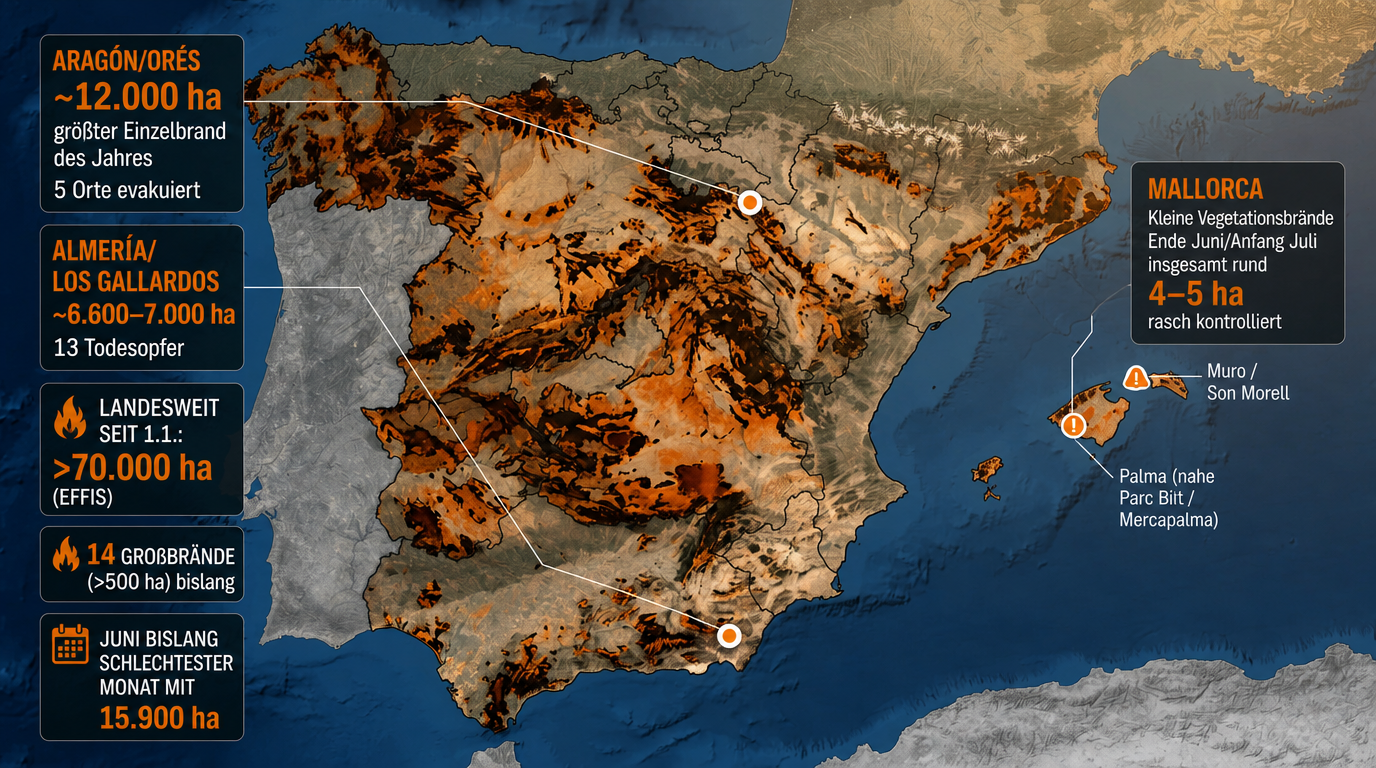
Aragon (Huesca / Zaragoza): The area affected is estimated at between 14,400 and 15,400 hectares. The fire is now largely under control. It is considered the largest single fire of the year so far; more than 1,100 people from five villages had to be evacuated.
Castile-La Mancha (Guadalajara): Around 13,000 hectares have been burnt. The fire in the Sierra Norte, north-east of Madrid, remains out of control. Over 500 residents from 20 municipalities have been evacuated.
Andalusia (Almería / Los Gallardos): Around 7,000 hectares have been affected. The fire is under control, but is considered the most devastating fire in over 20 years, as it claimed 13 lives. The majority of the victims were foreign residents.
Lozoyuela (Madrid region): Around 70 hectares of land were affected. The smaller fire on 16 July near the capital was brought under control quickly.
Balearic Islands (Mallorca): Around 5 hectares of land were affected. Minor vegetation fires in June and July 2026 were quickly extinguished.
Spain as a whole: Since 1 January, over 80,000 hectares of land have already been destroyed. The country has already recorded 14 major fires this year, each covering an area of over 500 hectares. Due to a persistent heatwave with temperatures ranging between 35 and 43 degrees, the risk of forest fires remains extremely high.
Arrest of individuals on suspicion of arson
-
- Madrid Region: During the forest fire near Lozoyuela north of Madrid, authorities arrested a man in July 2026who is suspected of having deliberately set the fire.
- In the Franco-Spanish border region of the Pyrenees, extreme forest fires occurred in early July 2026, fueled by a severe heatwave, extreme drought, and strong winds. The spreading fire also led to an adjustment of the third stage of the Tour de France. In many cases, authorities suspect arson and have arrested dozens of suspects across the country.
-
- Murcia: Authorities are investigating a massive wall of flames that swept through a forested area in the Murcia region in June 2026—forcing the evacuation of nearly 200 people—due to strong suspicions of arson.
- General pattern: The Spanish authorities and environmental organizations such as the WWF point out that, on average nationwide, around 86 percent of forest fires can be traced back to human fault (intentional acts/arson as well as negligence, such as discarded cigarettes). Only about 14 percent are proven to be caused by natural factors, such as lightning strikes.
Not every major fire this summer can be attributed to arsonists.
The Spanish government is increasingly responding to the changing threat landscape with repressive measures. In addition to temporary bans on the use of agricultural machinery during extreme weather, authorities are placing greater reliance on drone surveillance to catch perpetrators in the act. For the tourism sector and the local economy, this shifts the debate away from the framing of a purely natural disaster toward issues of internal security and the rigorous enforcement of criminal law.
Arrests in other countries
- Greece: In 2025 alone, more than 300 suspected arsonists were arrested following the introduction of stricter legislation, who had caused the fires intentionally or through gross negligence.
- USA: During the severe fires in California—such as the consequential Pacific Palisades blaze in Los Angeles—police repeatedly carry out targeted arrests of suspects held responsible for igniting the fires.
- Australia: During major bushfire crises, the military and police regularly track down individuals who deliberately set fires, at times arresting hundreds of suspects.