
Rissagas in the Balearic Islands – an unusual August 2026
August is one of the months when people in the Balearic Islands pay particular attention to rissagas. A ‘rissaga’ is neither ordinary swell nor a classic tsunami: it is caused by rapid changes in air pressure and atmospheric gravity waves, often associated with thunderstorms. If the disturbance encounters a bay or harbour that is susceptible to it, the movement of the sea level there can intensify significantly.
August 2026 saw an unusual spate of ‘meteotsunamis’ in the Balearic Islands. The phenomenon was particularly evident on 24 August 2026: in Mallorca, tidal surges were observed in Port de Sóller and Port d’Andratx. At the same time, warnings were in place in Menorca for sea-level fluctuations of up to 1.2 metres.
Ibiza was also affected on the same day. At Platja de s’Arenal and along the seafront promenade in Sant Antoni, the water rose unusually far onto the beaches, promenades and restaurant terraces.
What makes rissagas so distinctive is their apparent unpredictability: the sea can recede several times within a short period and then rise again. This does not necessarily result in high, breaking waves – rather, the water can surge into a harbour or bay like a massive, slowly ebbing and flowing tide.
August 2026 thus clearly demonstrates that it is not only Menorca, with its famous Rissaga hotspot in Ciutadella, that is affected. Mallorca and Ibiza, too, can experience significant fluctuations in water levels under the right atmospheric conditions. Sheltered harbours and bays, where the local geography amplifies the oscillation of the water, are particularly vulnerable.
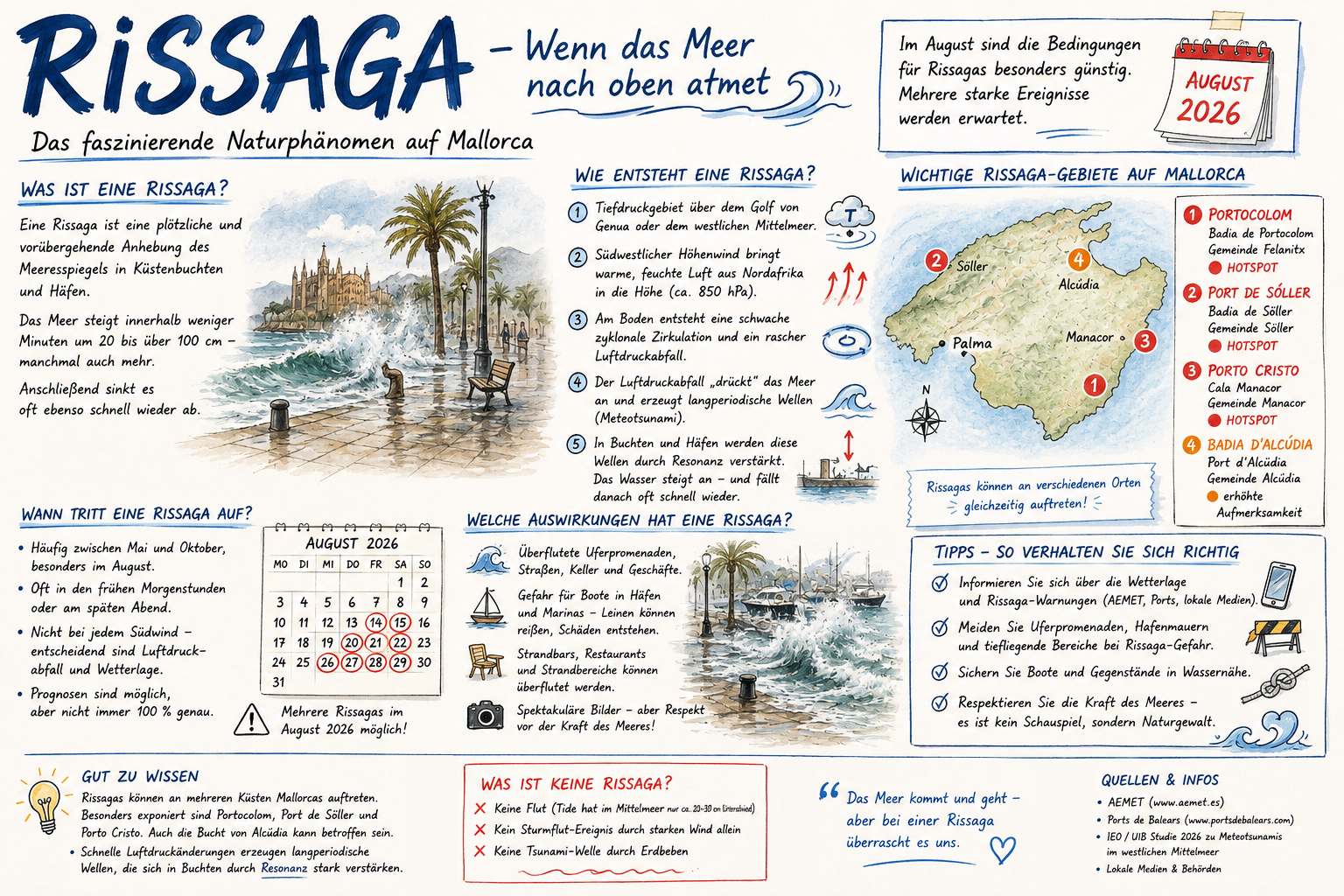
For Mallorca, this August has therefore been a remarkable Rissaga event: the combination of the documented events in Sóller and Andratx and the simultaneous warnings for other Balearic Islands makes it clear that meteotsunamis are an archipelago-wide weather and coastal phenomenon – by no means a problem exclusive to Menorca.