
El Niño 2026: What to expect
It begins far away from Europe, where the Pacific Ocean is at its widest. Off the coast of South America, the sea becomes unusually warm, and vast air masses alter their circulation – a weather phenomenon that originated thousands of kilometres away is also affecting travel plans in Europe.
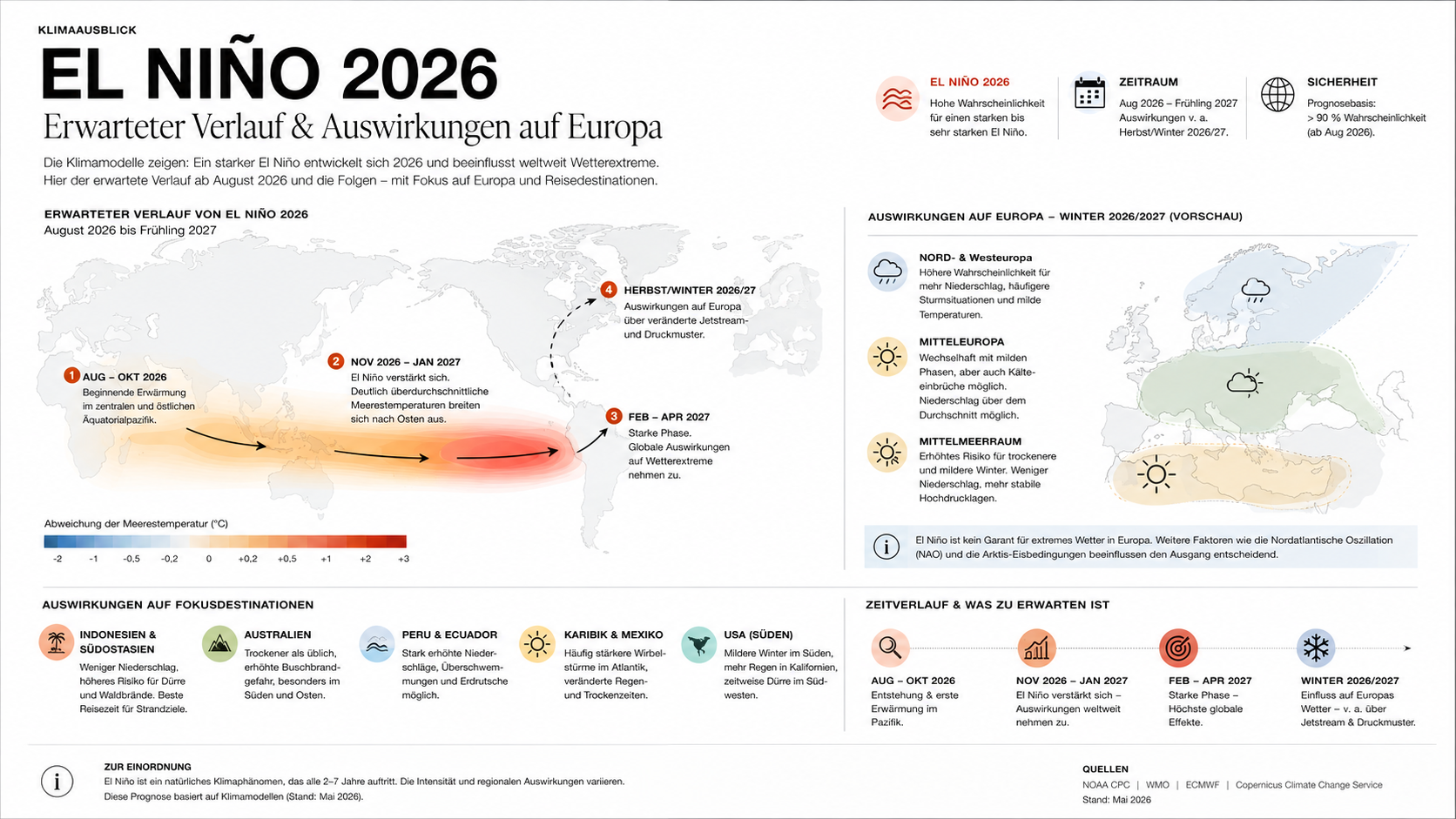
El Niño 2026 is no longer just a model prediction. According to the US National Oceanic and Atmospheric Administration (NOAA), the phenomenon is already well established and is intensifying. The probability of a very strong El Niño occurring in the autumn and winter of 2026/27 stands at around 90 per cent. NOAA even considers a historic course of events to be possible: for October to December, it states there is a 69 per cent probability that the intensity will exceed that of previous events since comparable records began.
However, this does not mean that a specific weather pattern can be predicted for every destination. El Niño shifts the probabilities, not the weather calendar. In Europe in particular, the correlations are significantly weaker than, for example, in the tropical Pacific. The ECMWF points out that El Niño effects in Europe vary from season to season and can sometimes even cancel each other out over the course of a whole winter.
The Pacific sets the pace
The signal is likely to be particularly pronounced in the traditional El Niño regions. Peru and Ecuador are among the countries that are particularly closely linked to the tropical Pacific. Significant changes in rainfall patterns can lead to flooding and landslides in these areas, whilst other regions suffer from drought at the same time.
The situation is different in Indonesia and parts of South-East Asia. In those areas, El Niño often brings less rainfall. For travellers, this sounds like perfect beach weather. For the regions affected, however, the drought can have significant consequences – for water supplies, agriculture and the risk of forest fires. The WMO expects a classic El Niño pattern overall for 2026: more rainfall in some regions, and a risk of drought in others.
Australia, too, has traditionally been affected. Drier conditions can increase the risk of fire. In parts of North America, meanwhile, rainfall and temperature patterns are changing; the effects extend from California to the southern United States.
And Mallorca?
For the Balearic Islands, the situation is complicated – and that is precisely what makes it interesting. Mallorca lies well outside the actual El Niño zone. A strong El Niño therefore does not automatically mean a dry or particularly warm winter in Mallorca. The effect is mediated through a chain of atmospheric interactions, in which, amongst other factors, the jet stream and the North Atlantic circulation play a role.
For travellers, this means that El Niño is more of a background factor for Mallorca than a specific weather forecast. In the Mediterranean region, rainfall patterns, temperatures and storm activity may change, but other factors – such as the North Atlantic Oscillation – are often more significant for the weather in Europe.
Europe’s winter under scrutiny
Things are set to get interesting here from autumn onwards. The WMO forecasts above-average temperatures worldwide and significant changes in precipitation patterns. No single scenario can be predicted for Europe as a whole. Atmospheric patterns are likely to shift: Northern Europe may be more heavily affected by precipitation and spells of storms, whilst dry spells may become more likely in the Mediterranean region.
For travellers, this is precisely the most important message: 2026/27 will not be a year when you can simply consult a twelve-month weather map. You should keep an eye on regional forecasts and short-term weather data.